














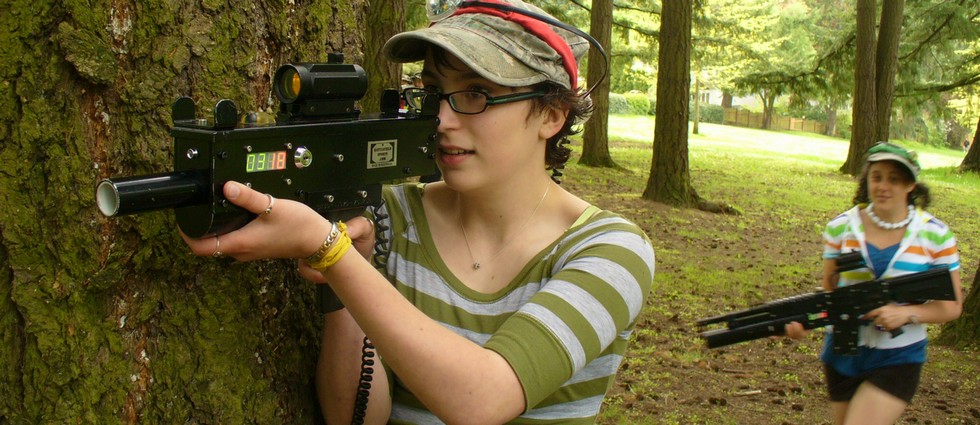
When good laser tag strategy tells you to do bad things…
At some point in playing you’ll occasionally find yourself without allies an in a situation where you’ll need to walk into a room you’re pretty certain is filled with enemies and try to be all Matrix-like and take them all out. This is an incredibly difficult tactic to accomplish and you’re literally choosing to walk into an ambush. Let’s start with some of the reasons that you might want to do this: (hint: if you can avoid it, good laser tag strategy says you probably should!)

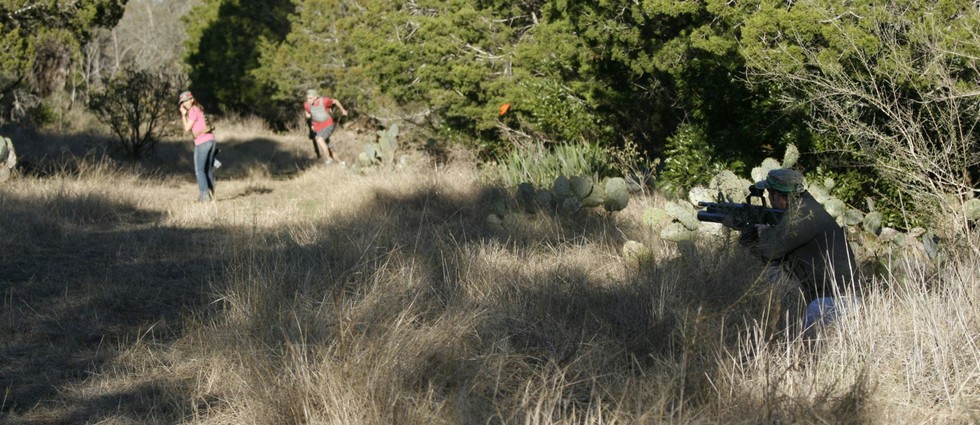
Clearing an outdoor area by yourself is even more dangerous than an indoor area. Solo clearing should always be a last-ditch laser tag strategy.
Reasons you might have to give up on good laser tag strategy:
- You’re defending a critical path or point (to your team’s flank, for instance) and you see the opponents starting to mass for a large push. (In this case, you might choose to attack early in the hopes of causing them to act sooner than they want to and when there are fewer opponents to defend against your attack now than there will be attackers on your position if you wait.)
- You’re playing a domination game and you’re the last defender from your team. Time is short and you’re likely to lose the domination point if you retreat or call for help.
- You’re attacking a point or area held by the enemy. They’ll receive reinforcements before you will and in the meantime are vulnerable in a way that will no longer be true after they are reinforced.
- You spot the opponents grouping up to take some action or maneuver on the field and if you wait they’ll gain more people and be able to attack in force against your team.
Note that in all of these examples the reason that you would act immediately as opposed to doing the (usually) smarter thing and waiting for backup is that at the current moment the opponents hold a weaker position than they will in a minute and you want to optimize on that opportunity. It’s important that the reason you’re acting solo against a group is never “because I like to lone wolf it all the way across a battlefield myself.” First, trying to clear an area solo is likely to get you killed, so it’s not at all what you’d prefer to do tactically and is rarely good laser tag strategy. Second, working your way across the field solo is dumb because you’re always fighting while outnumbered, you don’t have a second pair of eyes to watch your flank, and if you die there’s no one else to have the intel you’ve gathered about where on the field the opponents are and then call over support if needed. If you’re acting solo against a group make sure it’s always because there’s no better option. A better way to determine that you need to act immediately is that you have to, even if you don’t want to.
I also want to make sure we define exactly what a room is. A “room” could be…
- a completely enclosed space surrounded by walls.
- a partially enclosed space that is open on the sides towards the game boundaries, allowing you to safely assume there are no opponents in that direction who can shoot you.
- a small and relatively isolated outdoor area that is visually cut off from the rest of the battlefield.
- …or basically anywhere that you expect close-quarters combat without much threat of being sniped from a distance.
…but what’s good laser tag strategy when you MUST clear solo anyhow?
So you’re in a situation where you’re alone (we’ll talk about clearing a room with a group another time) and if you don’t act now then your opponent is going to get much stronger. So what do you do?
- Identify the “X”. The X is basically the danger zone, or the point where your opponents expect to pound you mercilessly when you enter the room.
- Back up from the X at least a step or two. You’ll need the space to gain speed in a moment. If you’re religious, now’s a good time to pray. You’re about to try something that is tactically inadvisable under almost any circumstances, blisteringly difficult to do well and even if you do it perfectly you can still end up walking back to the referee for a respawn.
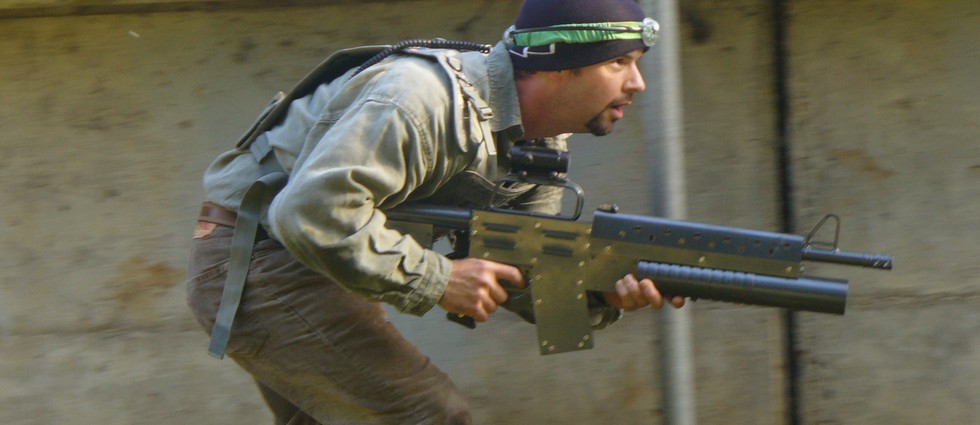
- Blow into the room and cross (and thus get off of) the X in a straight line with as much speed as you can while maintaining some reasonable accuracy (i.e.: not at a dead run). When you come through the door you need to already be at speed so you aren’t spending valuable time accelerating while you’re in the danger zone. Second, you want to cross the X in a straight line so that you don’t spend time turning or otherwise slowing down. There’ll be the rest of your in-game life to turn after you get off the X.
- Once you are completely past the X then pivot (don’t start pivoting while you’re still on the X!) and shoot at the opponent who is farthest from the X. This seems completely insane, so let me explain: when you came in fast through the X everyone needed to shift their point of aim if they wanted to stay targeted in on you. Everyone who’s closest needed to move their point of aim farther than the player in the back who had the smallest change in their angle of aim. That makes that farthest player the most dangerous, and since we’re talking about close-quarters distances (~25′ or less) you shouldn’t have any problem hitting accurately.
- Keep moving perpendicular to the direction that your opponents are shooting at you. This probably means you’re going to continue circling the room. As soon as one opponent dies you’ll pick another, probably the one farthest from you. Do not jump or stop behind cover. The moment you stop moving you become a very easy target to suppress. Your opponents will be able to pick you off as soon as you show your head.
- If you survived, then identify any doors you think enemy reinforcements might come in from. Once you do, you should stop somewhere that you can see them and respond quickly in case someone does enter, then probably take a deep breath and breathe for a minute before moving on.
Clearing a room solo is not something you’re likely to pull off unless you manage to get lucky in a few key areas. Things that will make you more successful are an explosive entry, fantastic accuracy, surprising your opponents, maintaining the highest possible rate of speed where you can sustain your accuracy, and a lot of luck. You MUST practice a difficult tactic like this before you can ever expect to be even mostly successful. Again, good laser tag strategy says you never want to clear something by yourself, but occasionally you’ll have a rare situation where it’s the only thing you can do.