













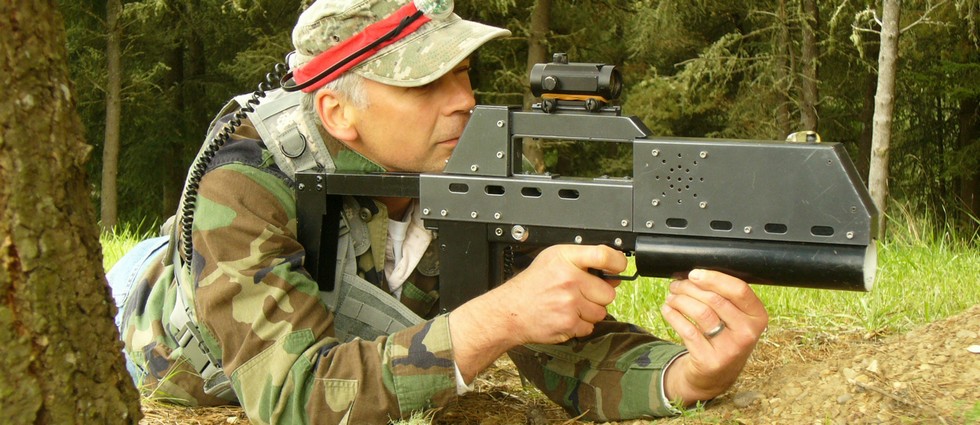










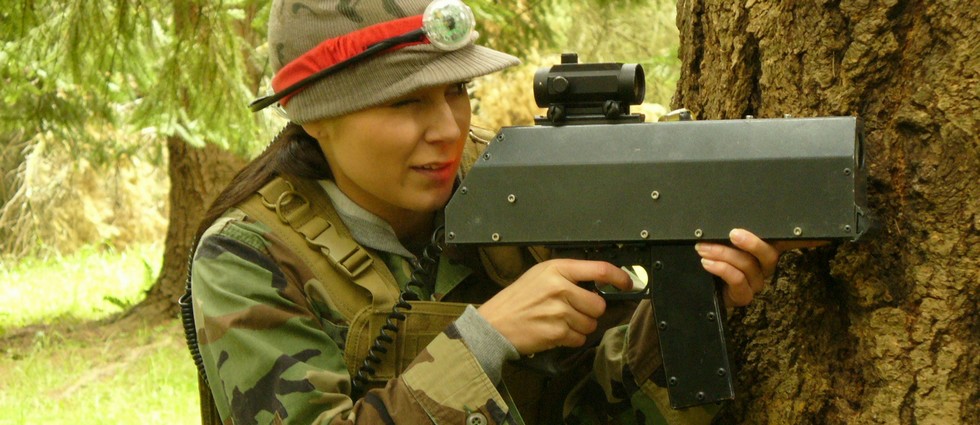



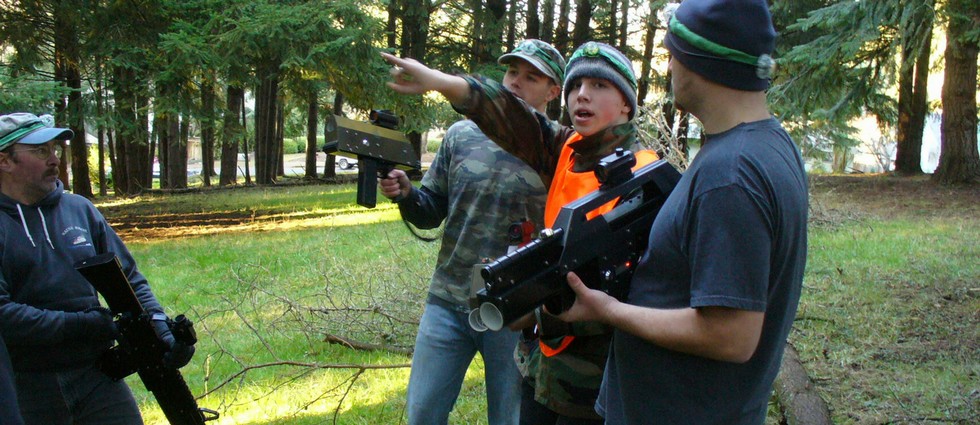
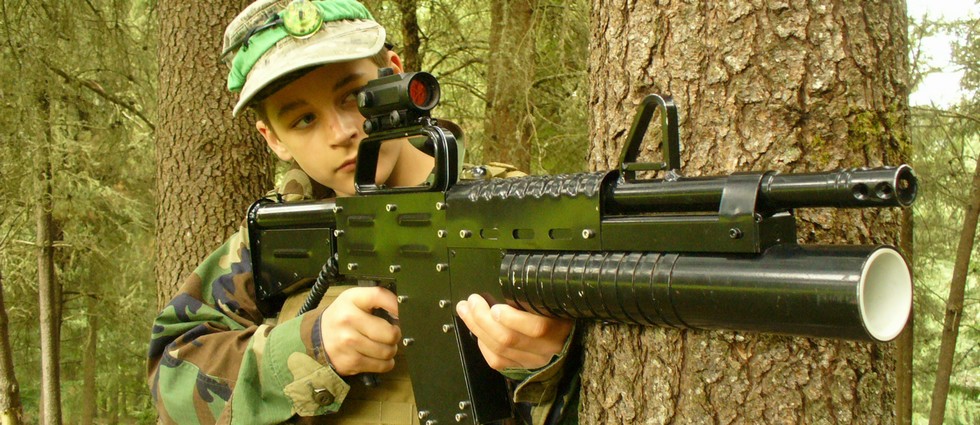













We wanted to give you a quick overview of how to play laser tag so you could see, before you arrive, how simple it really is. So here’s how to use the gaming guns we use on the field. (Alternately, are you looking for what your laser tag party will look like?)
Your Gaming Gun
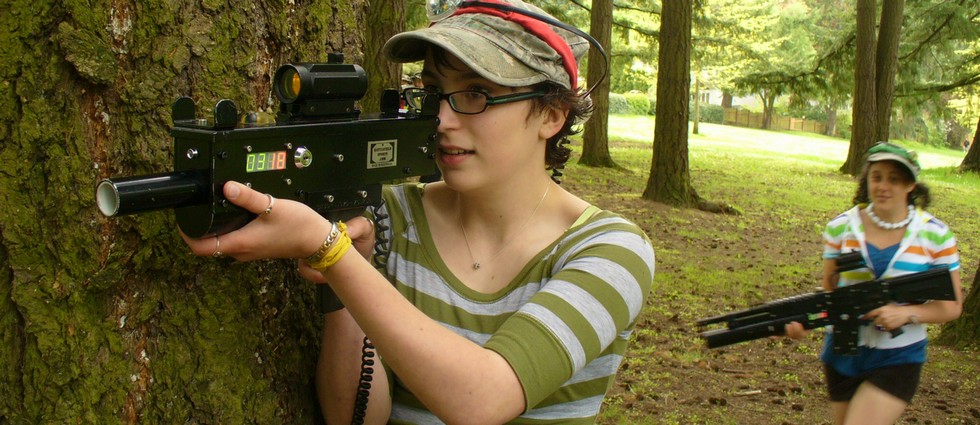
Your gun has a display with two numbers (red and green). When you shoot the red numbers go down. When you’re shot the green numbers go down.

Every gaming gun has a four-digit display and red-dot scope
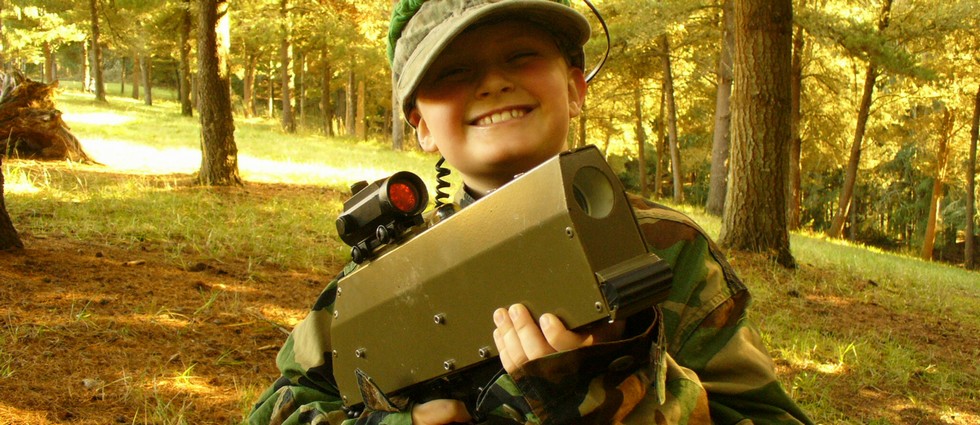
Shoot your opponents. Hits are registered by the sensors located on the front and back of the head as well as on the gun, (anywhere you look or shoot you can be shot from) but you’ve got a good deal of wiggle room, particularly in the front. Your gun has a red-dot scope on it. Use it or you almost certainly won’t be hitting anyone.
Also, near your trigger are two buttons. One on the right, one on the left. (Each model has them in slightly different places, so flip your gun over after you select it.) The one on the left is for reloading. Always remember: “Left is for load!” Press it once and you’ll hear a single click. That means you’ve got no bullets in your gun, so hide behind a rock, tree, or friend you don’t like very much and wait for the double-click. The double-click tells you that your gun is loaded and ready to fire. The button on the right changes your gun from fully auto (or rapid-fire, the default mode) and semi auto (or single-shot). We generally recommend you leave it in full auto, but when you play laser tag with our equipment you can choose whatever you like on the fly.
How to Win
Most games don’t actually count the deaths of players. Team objectives (and team scoring in every game) mean that you win or lose TOGETHER & there’s no individual scoring.
What, what? No individual scoring? That’s right. We do that for several reasons. First, the most important person on your team might be the guy who stayed back and helped coordinate or lead. He’s likely to fire very few shots. Individual scoring makes it look like he didn’t do anything when the real story is told by the team victory. Second, individual scoring has a great way of killing the fun at a party. Imagine a long, hard-fought game where the birthday guest of honor finds at the end that they never hit the broad side of a barn. At that point it doesn’t matter whether the team won or lost. What matters is that now no one is having a good time because the guest of honor is upset.
Look at it another way: team scoring is the only realistic scoring system. It doesn’t matter if you slaughtered the entire opposing team but your team failed as a whole to actually retrieve the secret documents, deliver the bomb, decode the message, retrieve the flag, etc. What matters is whether your team (as a whole) managed to actually achieve its goal. It’s also silly to brag about having the most kills when you play laser tag if the other team averaged fewer deaths per player than your team did to actually pull out the win. In both cases while individual scoring would say that you topped the field the actual result indicates that you probably should have spent more time working as a team. That’s why we only use team scoring; you have to work together to win.